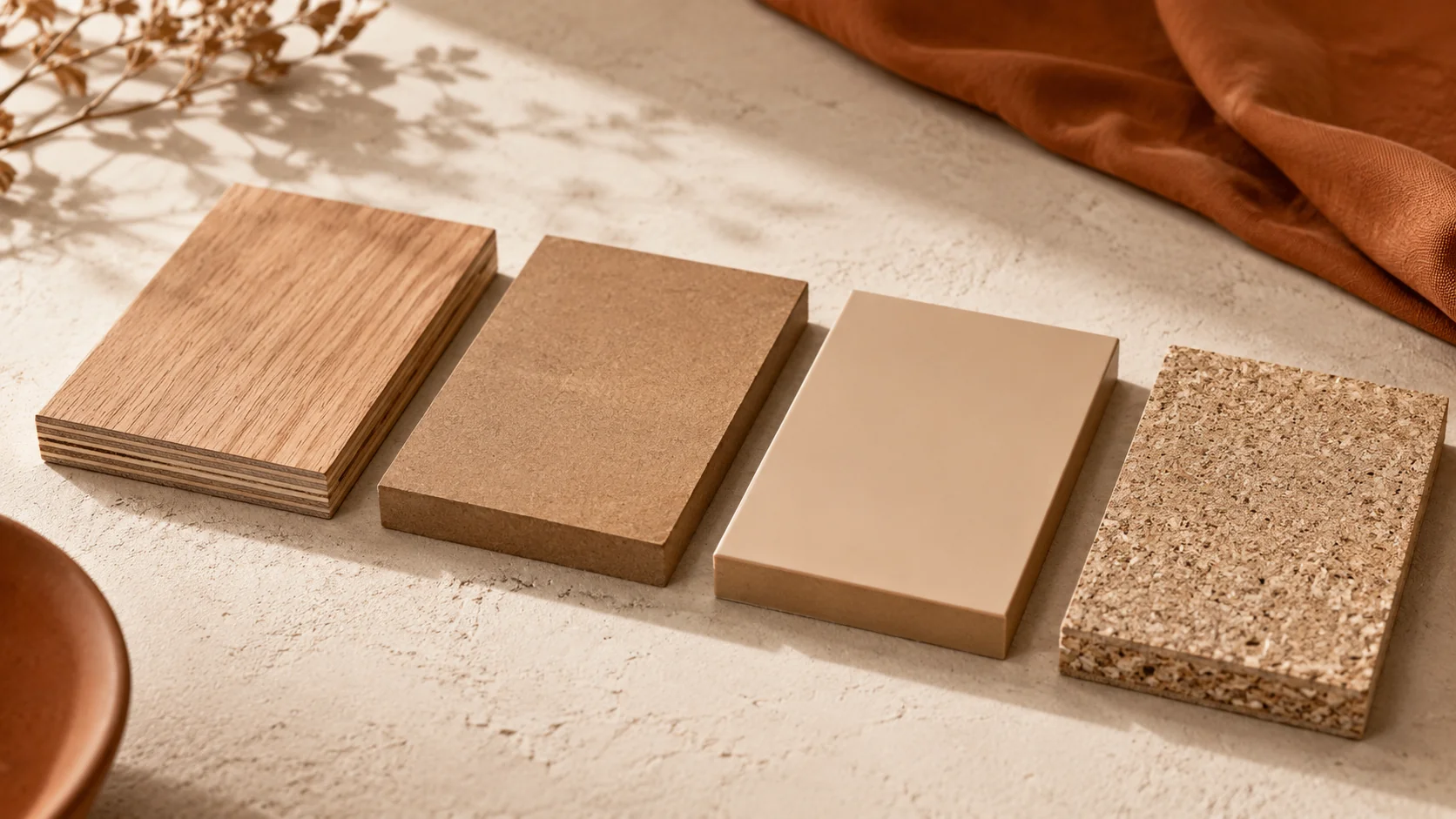
If you've started researching interior design for your 2BHK or 3BHK flat, you've probably run into a wall of unfamiliar terms. BWP, BWR, MR grade, MDF, HDHMR, particle board, all thrown at you fast by a salesperson trying to close a deal. Most homeowners end up picking blind and hoping for the best.
Here's the thing: the material behind your modular kitchen, wardrobes, and TV units matters more than the finish on top of it. Get it wrong, and you're looking at swelling, warping, or termite damage within a couple of years, especially in Bangalore's mixed humidity conditions. Get it right, and it lasts for decades. If you're also weighing shutter finishes on top of the base material, our laminate vs acrylic vs Duco comparison is a useful companion to this post.
This guide breaks down what these materials actually are, where each one belongs in your home, and the questions you should be asking before you sign off on anything.
Plywood: The Workhorse Material
Plywood is made by gluing together thin layers of wood veneer, called plies, with each layer's grain running across the next one. That cross graining is what gives it strength and resistance to warping.
BWP Plywood (Boiling Waterproof)
This is the gold standard for kitchens, bathroom cabinets, and any area with regular moisture exposure. BWP ply is tested by literally boiling it. If it survives without the layers separating, it passes. For a kitchen in particular, this is not optional. It is the baseline.
BWR Plywood (Boiling Water Resistant)
This is often confused with BWP, but it's a step down. BWR can handle occasional moisture but isn't built for constant exposure. It works fine for wardrobes and living room units, but it's not ideal for kitchens or cabinets near bathrooms.
MR Grade (Moisture Resistant)
This is the most basic and least durable of the three. It's cheaper, and that's really its only advantage. We would only recommend MR grade for low moisture, low use areas like a study unit or a decorative shelf. Never for a kitchen.
MDF (Medium Density Fibreboard)
MDF is made from wood fibers compressed with resin under heat and pressure. It has no grain, which means it gives you a perfectly smooth, uniform surface. This makes it ideal for modern, flat panel designs, painted finishes, and detailed CNC cut patterns like jaali or fluted panel work.
The trade off is that standard MDF is more sensitive to moisture than plywood. If you love the sleek MDF look for your living room or bedroom wardrobes, that's a great choice. For kitchens, insist on moisture resistant MDF at minimum, and keep in mind it's still not as tough as BWP plywood in wet areas.
HDHMR (High Density High Moisture Resistant)
HDHMR is a denser, tougher version of MDF. It goes through extra compression, which makes it stronger, more resistant to moisture, and less likely to chip or crack at the edges compared to standard MDF.
Because of that added strength, HDHMR is a popular choice for kitchen shutters, wardrobe shutters, and areas that need both a smooth finish and better durability. It costs more than regular MDF, but for many homeowners it hits a good middle ground between the sleek look of MDF and the toughness of plywood. It's still not quite as water resistant as BWP plywood, so we wouldn't recommend it for areas with direct water contact, such as under the kitchen sink.
Particle Board (also called PB or Chipboard)
Particle board is made from wood chips and sawdust bonded with resin. It's essentially the most budget friendly of the three, and it's commonly used in ready made, mass produced furniture.
It does have its place. It works for low budget projects, low moisture rooms, or furniture you don't expect to keep for fifteen years or more. But it's the least tolerant of moisture and physical stress, and repairs are harder once it swells or crumbles at the edges.
So Which One Should You Choose?
| Application | Recommended Material |
|---|---|
| Kitchen cabinets and shutters | BWP Plywood or HDHMR |
| Bathroom adjacent units | BWP Plywood |
| Wardrobes | BWR Plywood, HDHMR, or MR grade MDF |
| TV units and living room units | Plywood, MDF, or HDHMR, depending on design |
| Study units and low use shelving | MR Plywood or Particle Board |
| Painted or flat panel modern designs | MDF or HDHMR |
Three Questions to Ask Any Designer or Contractor
1. "What grade of plywood are you using, specifically, for the kitchen?" If the answer is vague, such as "good quality ply," push for the actual grade: BWP, BWR, or MR.
2. "Can I see the material certification or brand?" Reputable brands, like Century Ply, Greenply, and Kitply, stand behind their grading. Unbranded material is a red flag, especially at kitchen grade pricing.
3. "What is your warranty on materials versus workmanship?" These are often different, and it matters which one covers what.
We use BWP grade plywood as standard, and we tell you upfront.
We use BWP grade plywood as standard for all kitchen and wet area cabinetry, and we're upfront about material grade at the quotation stage, not after you've already signed. Every project comes with daily execution updates, so you can actually see what's going into your home as it's built, rather than just taking our word for it afterward. If you're currently comparing quotes and the material specs feel unclear, it's worth clarifying before you commit. This is one of the biggest factors in how your interiors hold up over the next ten to fifteen years.
Book a Free Consultation